 Fraunhofer Institute for Digital Media Technology IDMT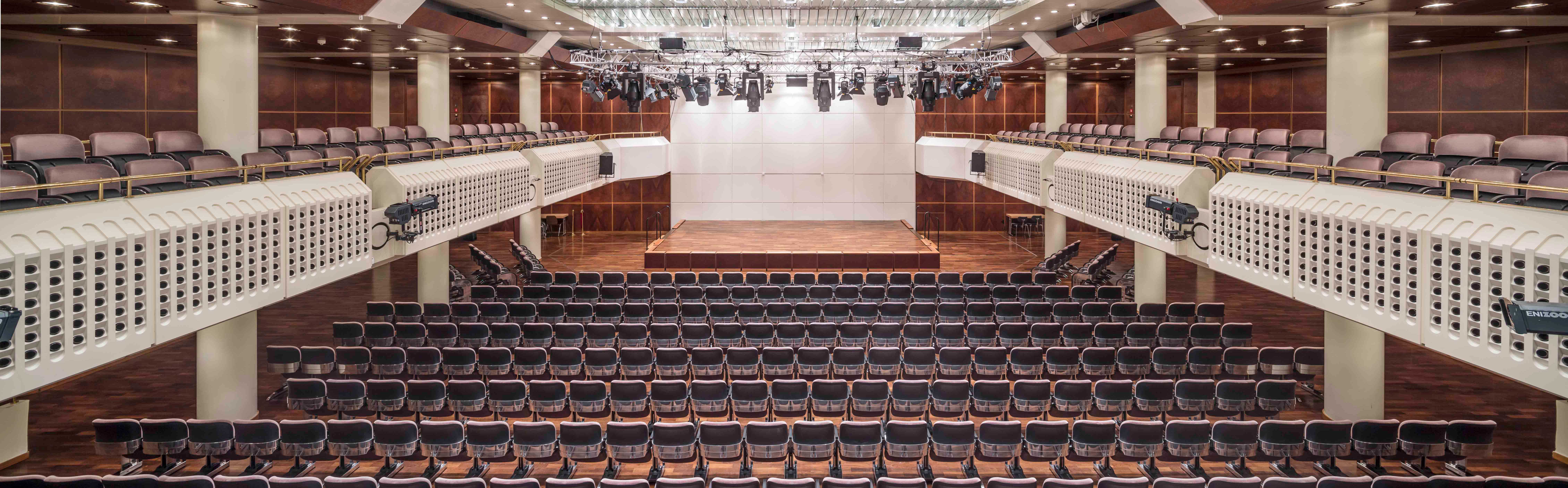
The Alte Oper Frankfurt is one of Germany's most renowned concert halls, celebrated for its diverse programme and excellent sound quality. Following the example of the Grosser Saal, the Mozart Saal, which seats over 700 people, is now set to receive an equally impressive acoustic system. To this end, the Alte Oper is breaking new ground: within the framework of a research project initiated jointly with the non-profit Hertie Foundation, an AI-based solution for the automated monitoring and control of room acoustics in the Mozart Saal is being developed. With the help of artificial intelligence, room acoustic parameters such as total energy and reflections are estimated in real time from natural audio signals and used to dynamically adjust the electronically generated room acoustics. This ensures that the room acoustics remain constant and optimal, regardless of factors such as audience occupancy, furniture, or stage setup.
Challenge: Variable room acoustic requirements in multi-purpose concert halls
Modern event venues are used for a wide variety of purposes, from classical music and spoken word events to entertainment shows. The requirements for room acoustics are correspondingly diverse, which is relevant not only for the concert experience of the audience, but also for the musicians. Classical concert rehearsals often take place without an audience, which leads to significantly altered acoustic conditions during the performance. The reason: the audience absorbs the sound, thereby changing the reverberation time and the overall volume of the room. For the musicians, this creates a “drier” sound space, which can significantly influence the feel of the performance. To compensate for this effect, electronic room acoustic enhancement systems are used. Microphones and loudspeakers distributed throughout the room generate additional reflections, thereby increasing the sound energy in the hall. However, these systems are usually configured before the performance – for example, during the dress rehearsal – and are not adjusted during the concert. As a result, they cannot fully compensate for the changed acoustic conditions caused by the audience – and their full potential remains untapped.
Research approach: AI-supported real-time analysis of room acoustics
The project pursues a three-stage methodological approach:
- Acoustic data collection and modeling of real concert situations
A comprehensive data set is being created that maps various acoustic scenarios in real and simulated concert halls – including conditions with and without an audience. Among other things, 3D audio special rooms at Fraunhofer IDMT and real measurement series in the Mozart Hall of the Alte Oper Frankfurt are being used. - Development of AI algorithms for room acoustics estimation from audio signals
With the help of machine learning and deep learning techniques, acoustically relevant features such as reverberation time and energy distribution are extracted from natural, live-recorded audio signals – without the need for special measurement signals. The goal is to create a robust, resource-efficient system that reliably estimates acoustic parameters in real time. - Integration into existing electronic room acoustics systems
A central concern of the project is to connect the developed AI-supported room acoustics analysis to existing electroacoustic systems. The aim is not to replace existing systems, but to expand them with intelligent, data-based control. The control system is to be integrated directly into the existing infrastructure via standardized interfaces.
Areas of application and future potential of AI-supported room acoustics control
The adaptive optimization of room acoustics represents a technological innovation with high application potential – not only for concert halls and event venues. Other areas of application include, for example, the filtering of reverberant audio signals in communication applications such as mobile telephony or video conferencing systems, as well as adaptive audio playback in vehicles to change the perceived size of the vehicle cabin.